

Congratulations!! You submitted your Primary Application, and now it is time for… Secondaries.
What are Medical School Secondary Applications?
After submitting your Primary Application, and it gets approved, Medical Schools will send secondaries as the next step of the application process. Secondaries are a school-specific supplementation to your original application.
They typically consist of 3-10 additional essays ranging from 300 to 3500 characters each. (Sometimes more!)
It is courtesy to return secondary essays within two weeks of receiving them. (And by courtesy, I mean – you should!) The quicker you return your essays the happier a school will be. This makes them believe that you are serious about enrolling in their school and because schools use rolling admissions, the earlier you send them in, the better.
Usually, you will receive your secondary application requests within days of each other. That means you might have about 40 essays to juggle all at once. I recommend prewriting secondaries to make them a little more manageable.
Prewriting Secondaries
Because of the quick two-week turnaround, it is common for students to pre-write secondaries.
You will not know the school’s secondary prompts until they send them to you, or a list is made for the new year, but usually, the prompts don’t change much so you can use last year’s list of prompts to write ahead and cross your fingers that they won’t change.
Here is a list of all of the TMDSAS secondaries from last year’s application cycle.
US Medical School Secondary Prompts 2023-2024
You can research each specific school to see how often they change their prompts if you are worried about them changing.
Why are Secondaries Important?
Your primary application shows medical schools why you want to be, and why you would be a good physician, but secondaries help medical schools decide if you will be a good fit at their specific school. Each medical school is unique, they have their mission statement, values, and culture they are trying to maintain, so when it comes to writing secondaries, you shouldn’t write them all the same.
How to write secondaries?
1. Stay Organized
Because of the two-week turnaround, I wanted to make sure that I stayed on top of the deadlines for each school so I made a ~spreadsheet~
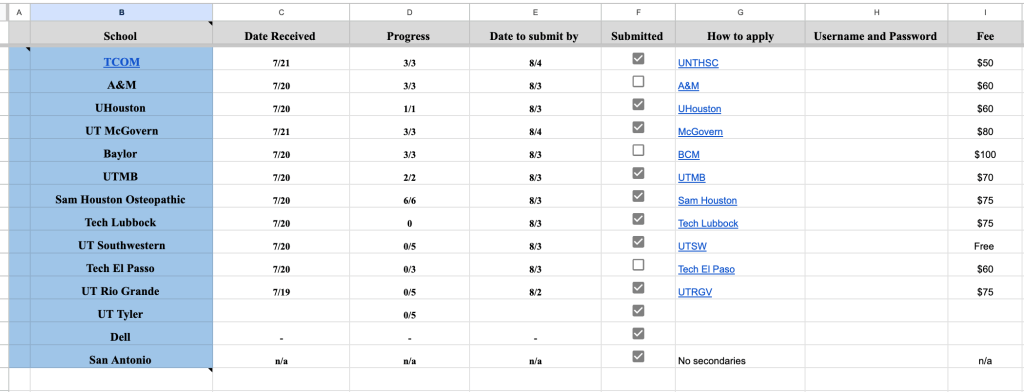
This is an edited example of what mine looked like.
For each school, I linked a separate document (see the TCOM example hyperlinked in blue) that took me to the essay prompts. I wrote the date received and the date I would need to turn it in and marked my progress on each essay. There is a place to add costs, check off when you have submitted, store your password for each sight, and add friends and family to review your essays!
I liked my template here if you would like to use it to stay organized.
Secondary Apps – Template
2. Research your schools
This is my BIGGEST piece of advice for writing secondaries!
For EVERY school that you write secondaries for the FIRST thing you should do is look for their values and mission statement.
Write down:
- Mission Statement
- Values
- Other things mentioned about culture or what they are looking for in applicants
- The emphasis the school has on research
- What populations do the schools treat
- Does the school focus on primary or specialized care
3. Write down each school’s values and use them as a guide when writing your secondaries
Between primaries and secondaries, medical schools are trying to narrow down thousands of applicants into 50 to 250 medical students. In theory, most everyone will be a good doctor, but schools want to find applicants who will not only be good doctors but be good students at their institution. They want a new class that will continue and build upon their legacy!
Because of this, you will want to tailor each of your secondary essays to the school’s mission statement or one of its values.
For the schools I applied to, I tried to sprinkle each value that the school had among my 3-10 essays.
Example:
School Value: Collaboration, Innovation, Leadership
Secondary prompt: “Tell us about a time you failed”
I would pick a value or two from above for this essay prompt and try to incorporate it into my response. For example, I could pick collaboration and leadership for the failure prompt. I could write about a time I failed when collaborating on something that I had a leadership role in (research project, student organization, etc). How did I fail as a leader or how did I fail when working as a team? Then I could emphasize the things that I learned from it, why I failed, how I strengthened my collaboration and leadership skills, and how I now actively work to collaborate and lead better. With failure prompts be sure to emphasize resiliency and how you actively worked to bounce back!
I know this example is vague but I hope it helps you get an idea of how to tailor your responses to the school’s values to show them that you would be a good fit!
Things to Remember when Writing your Secondaries:
- Show don’t tell. As mentioned previously in my primary and personal statement blog, you should try to show the reader that you are “compassionate” for example, rather than tell them you are. When was a time you showed compassion, integrity, or leadership? Paint the picture for the reader.
- It is more important to show what you learned than to extensively tell the story of why you were wrong. Many secondary prompts ask about failures or setbacks and how you handled them. I recommend addressing the setback quickly in the first 1/4 to 1/3 of the essay and spending the rest of the time telling your story of what you learned and how you improved from it.
I hope this secondary blog was helpful!
Good Luck writing your secondaries and hand in there! Make sure you take care of yourself during this time! Take breaks. Go on walks, exercise, and have meals with friends or family. Go on a drive and listen to your favorite music.
♡ Z
Tip:
Bouncing ideas off of friends and family was super helpful during this time! Just talking things out loud made everything make sense!
 Zoe Martinez
Leave a comment